


About
Yellowstone National Park is located primarily in northwestern Wyoming, with portions extending into Montana and Idaho in the United States. Covering approximately 3,472 square miles (8,991 sq km), Yellowstone is the first national park in the world and one of the most influential protected areas in conservation history.
Established in 1872, the park protects a vast landscape of geothermal features, mountains, forests, rivers, lakes, and wildlife-rich valleys. It lies south of Gallatin National Forest and adjoins Grand Teton National Park to the south. Together, these protected lands form the core of the Greater Yellowstone Ecosystem, one of the largest intact temperate ecosystems on Earth.
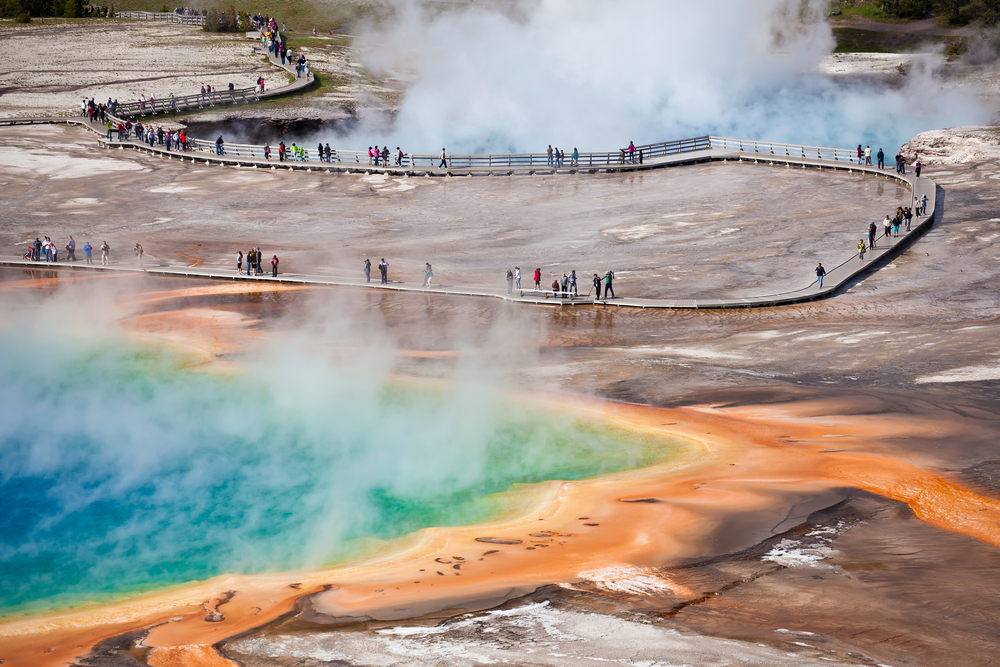
Yellowstone National Park is best known for its extraordinary geothermal features. The park contains more than half of the world’s active geysers and hydrothermal systems. Visitors from around the globe come to witness the eruption of Old Faithful, explore colorful hot springs such as Grand Prismatic Spring, and observe bubbling mud pots and steaming fumaroles.
Beyond its geothermal wonders, Yellowstone offers exceptional opportunities for hiking, wildlife viewing, camping, fishing, boating, photography, and scenic driving. Its combination of geological marvels and abundant wildlife creates one of the most memorable visitor experiences in the world.
The geography of Yellowstone National Park is shaped by powerful volcanic forces. The park sits atop the Yellowstone Caldera, one of the largest active volcanic systems on Earth. Massive eruptions over thousands of years helped create the landscape seen today. Elevations range from approximately 5,300 feet (1,615 meters) to over 11,300 feet (3,445 meters), producing a wide variety of ecosystems. The park contains mountain ranges, alpine meadows, forests, waterfalls, deep canyons, and expansive lakes.
Yellowstone Lake is the largest high-elevation lake in North America. Dense forests of lodgepole pine dominate much of the landscape, while sagebrush plains, wetlands, and grasslands provide important habitat for wildlife. Rivers such as the Yellowstone and Snake originate within the region and support critical ecological processes throughout the American West.
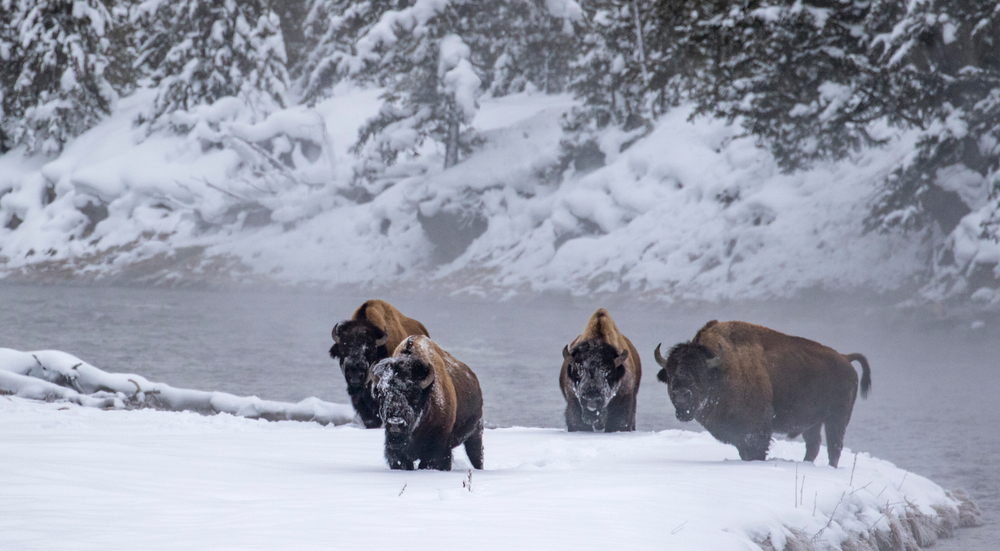
Wildlife within Yellowstone National Park is among the most impressive in North America. The park is home to the continent’s largest concentration of free-ranging mammals in the lower forty-eight states. Visitors frequently encounter American bison, elk, pronghorn, mule deer, and bighorn sheep. Predators include gray wolves, grizzly bears, black bears, coyotes, cougars, and wolverines. The successful restoration of wolves has become one of the world’s most celebrated conservation achievements.
Birdlife is equally diverse, with bald eagles, golden eagles, trumpeter swans, sandhill cranes, osprey, and numerous migratory species inhabiting the park. Native fish, amphibians, reptiles, and countless smaller organisms contribute to the park’s remarkable biodiversity.
Yellowstone National Park protects one of the most significant natural landscapes on Earth. It safeguards globally important geothermal systems, vast wildlife habitats, critical migration corridors, and ecosystems that function largely as they did centuries ago. Conservation efforts focus on preserving ecological integrity while protecting threatened species and maintaining natural processes across the Greater Yellowstone Ecosystem.
The park is often compared to Serengeti National Park and Kruger National Park because of its scale, wildlife abundance, and global significance. Yet Yellowstone’s combination of geothermal wonders, large mammals, and wilderness landscapes remains unmatched anywhere in the world. Today, it stands as a symbol of conservation and a reminder of the importance of protecting nature for future generations.
Photos




Things to See
Yellowstone National Park Trails
Yellowstone National Park is one of those places where so much of it can be experienced from the road with short stops and easy short hikes to experience the abundant natural wonders that are experienced across the park boundaries. However, hiking is one of the best ways to experience the splendor of Yellowstone in a more intimate and personal manner.

Park Protection
 Yellowstone National Park was created to protect an extraordinary combination of geothermal features, wildlife, forests, rivers, and mountain ecosystems centered around the Yellowstone Caldera, one of the largest active volcanic systems in the world. The park provides critical habitat for numerous species of conservation concern, including grizzly bears, Canada lynx, wolverines, and native Yellowstone cutthroat trout. It also supports the largest free-ranging bison herd on public land in the United States, along with wolves, elk, moose, pronghorn, and hundreds of other wildlife species.
The park is globally significant for protecting more than half of the world’s known geothermal features, including geysers, hot springs, mud pots, and fumaroles. Famous landmarks such as Old Faithful represent geothermal processes found in few places on Earth. Together, Yellowstone National Park safeguards unparalleled geothermal resources, intact wildlife ecosystems, critical watersheds, and one of the most important natural landscapes in the world.
FAQ’s
What is the main reason people visit Yellowstone National Park?
Yellowstone National Park is primarily visited for its world-famous geothermal features, abundant wildlife, dramatic landscapes, waterfalls, lakes, and outdoor recreation opportunities. Established in 1872, Yellowstone was the world’s first national park and remains one of the most iconic protected areas on Earth.
Visitors come to witness erupting geysers, colorful hot springs, roaming bison, wolves, bears, alpine scenery, and some of the most extraordinary geological features found anywhere in the world.
What animals can visitors hope to see in Yellowstone National Park?
Yellowstone National Park supports approximately 67 mammal species and is considered one of the premier wildlife viewing destinations in North America.
Some of the most notable animals found in Yellowstone National Park include:
- American Bison
- Elk
- Moose
- Pronghorn
- Mule Deer
- White-tailed Deer
- Bighorn Sheep
- Mountain Goat
- Gray Wolf
- American Black Bear
- Grizzly Bear
- Mountain Lion
- Bobcat
- Coyote
- Red Fox
- River Otter
- American Beaver
- Mink
- American Marten
- Wolverine
- Fisher
- Long-tailed Weasel
- Ermine
- Porcupine
- Snowshoe Hare
- White-tailed Jackrabbit
- Yellow-bellied Marmot
- Hoary Marmot
- Uinta Ground Squirrel
- Golden-mantled Ground Squirrel
- Least Chipmunk
- Uinta Chipmunk
- Red Squirrel
- Northern Flying Squirrel
- Deer Mouse
- Meadow Vole
- Long-tailed Vole
- Water Shrew
- Masked Shrew
- Northern Pocket Gopher
- Big Brown Bat
- Hoary Bat
- Silver-haired Bat
- Little Brown Bat
- Long-eared Myotis
- Long-legged Myotis
- Fringed Myotis
- Yuma Myotis
- Pallid Bat
- Townsend’s Big-eared Bat
How many bison are there in Yellowstone National Park?
Yellowstone contains the largest continuously free-ranging population of American bison in the United States.
Current estimates generally range between 4,000 and 6,000 bison, depending on the season, annual reproduction, winter mortality, and management actions. The population fluctuates from year to year but is typically maintained within this range.
Interesting facts:
- Yellowstone bison are considered the only continuously wild, free-roaming bison population in the lower 48 states.
- They descend from a small remnant population that survived the near-extinction of bison in the late 1800s.
- Adult bulls can weigh up to 2,000 pounds (907 kg).
- During summer, large herds are commonly seen in:
- Lamar Valley
- Hayden Valley
- Firehole River Area
How many wolves are there in Yellowstone National Park?
Yellowstone currently supports approximately 90–120 wolves living in roughly 8–12 packs, although numbers vary annually.
Important context:
- Wolves were reintroduced to Yellowstone in 1995–1996 after being absent for nearly 70 years.
- The original reintroduction involved 31 wolves from Canada.
- The park’s wolf population has fluctuated considerably over time.
- The broader Greater Yellowstone Ecosystem contains more wolves than the park itself.
The best places to see wolves are:
- Lamar Valley
- Slough Creek
- Soda Butte Valley
- Hayden Valley
Wolf viewing is generally best at dawn and dusk.
What birds can visitors hope to see in Yellowstone National Park?
Yellowstone National Park is home to more than 300 bird species. Its forests, rivers, lakes, mountains, and grasslands support a tremendous diversity of birdlife.
Some of the most popular birds seen in Yellowstone National Park include:
- Bald Eagle
- Golden Eagle
- Osprey
- Peregrine Falcon
- Prairie Falcon
- American Kestrel
- Northern Goshawk
- Cooper’s Hawk
- Sharp-shinned Hawk
- Great Horned Owl
- Northern Pygmy Owl
- Boreal Owl
- Common Raven
- Clark’s Nutcracker
- Gray Jay
- Steller’s Jay
- Black-billed Magpie
- Mountain Chickadee
- Black-capped Chickadee
- Red-breasted Nuthatch
- White-breasted Nuthatch
- Brown Creeper
- American Dipper
- House Wren
- Rock Wren
- Mountain Bluebird
- Western Bluebird
- Hermit Thrush
- American Robin
- Townsend’s Solitaire
- Cedar Waxwing
- Bohemian Waxwing
- Pine Grosbeak
- Evening Grosbeak
- Pine Siskin
- Red Crossbill
- White-winged Crossbill
- Dark-eyed Junco
- White-crowned Sparrow
- Fox Sparrow
- Savannah Sparrow
- Yellow Warbler
- Wilson’s Warbler
- MacGillivray’s Warbler
- Western Tanager
- Black-headed Grosbeak
- Hairy Woodpecker
- Downy Woodpecker
- Northern Flicker
- Trumpeter Swan
Is Yellowstone National Park worth visiting?
Yes, Yellowstone National Park is absolutely worth visiting and is widely considered one of the greatest national parks in the world.
The park offers unmatched geothermal features, extraordinary wildlife viewing, dramatic waterfalls, mountain scenery, alpine lakes, extensive hiking opportunities, and fascinating geological history. Few places on Earth combine such a diverse range of natural wonders within a single protected area.
The primary hesitation is that Yellowstone is extremely popular during summer, and major attractions can become crowded. However, the park’s immense size means visitors can still find solitude away from the busiest areas.
How many geothermal features are there in Yellowstone National Park?
Yellowstone contains approximately 10,000 geothermal features, representing the largest concentration of geothermal activity anywhere on Earth.
These include:
- Geysers
- Hot springs
- Mud pots
- Fumaroles (steam vents)
- Travertine terraces
Of those geothermal features:
- Approximately 500 are active geysers.
- This represents roughly half of all active geysers on Earth.
What are the most famous geothermal features in Yellowstone?
1. Old Faithful
The world’s most famous geyser.
- Erupts approximately every 60–110 minutes.
- Eruptions typically reach 100–180 feet (30–55 m).
- One of the most predictable natural phenomena in the world.
2. Grand Prismatic Spring
The most photographed geothermal feature in Yellowstone.
- Largest hot spring in the United States.
- Third-largest hot spring in the world.
- Famous for its vivid blue, green, yellow, orange, and red colors created by heat-loving microorganisms.
3. Mammoth Hot Springs
Known for:
- White travertine terraces.
- Constantly changing formations.
- Unique appearance unlike any other geothermal area in Yellowstone.
4. Norris Geyser Basin
The hottest and most dynamic geothermal basin in Yellowstone.
Features:
- Extreme temperatures.
- Frequent geothermal changes.
- Home to Steamboat Geyser.
5. Steamboat Geyser
The world’s tallest active geyser.
- Can erupt over 300 feet (91 m).
- Taller than Old Faithful.
- Eruptions are unpredictable.
6. Artist Paint Pots
Famous for:
- Bubbling mud pots.
- Colorful mineral deposits.
- Excellent examples of Yellowstone’s hydrothermal diversity.
7. West Thumb Geyser Basin
Unique because:
- Geothermal features sit directly beside Yellowstone Lake.
- Some hot springs occur beneath the lake itself.
How does Yellowstone compare with the numbers?
Yellowstone by the Numbers
| Feature | Approximate Number |
|---|---|
| Geothermal Features | ~10,000 |
| Active Geysers | ~500 |
| Percentage of World’s Active Geysers | ~50% |
| Bison | ~4,000–6,000 |
| Wolves | ~90–120 |
| Mammal Species | 67 |
| Bird Species | 300+ |
| Size of Yellowstone | 2.2 million acres |
No other national park in the world combines such a large concentration of geothermal features with free-ranging bison, wolves, grizzly bears, and extensive wilderness, which is one reason Yellowstone remains one of the most famous protected areas on Earth.
What is the best time to visit Yellowstone National Park?
The best time to visit Yellowstone National Park is from June through September.
Typical conditions include:
- June: 35–75°F (2–24°C)
- July: 40–80°F (4–27°C)
- August: 40–80°F (4–27°C)
- September: 30–75°F (-1–24°C)
During this period:
- Most roads are open.
- Wildlife viewing is excellent.
- Hiking trails are accessible.
- Visitor services operate fully.
- Geothermal areas are easily accessible.
September is especially popular because of cooler temperatures, fewer crowds, and elk rut activity.
How many days do you need to visit Yellowstone National Park?
You can drive around Yellowstone in a day and see a lot of what it offers, but you are not really experiencing the what makes the park so special. You have to get out and explore.
Most visitors should plan for 3 to 5 days.
- 1 day: Major geothermal highlights.
- 2–3 days: Geysers, wildlife, waterfalls, and scenic drives.
- 4–5 days: Comprehensive exploration of the park.
- 6+ days: Extensive hiking, photography, fishing, and wildlife viewing.
Because Yellowstone covers more than 2.2 million acres, longer visits are highly recommended.
How do you get to Yellowstone National Park?
Yellowstone National Park spans portions of Wyoming, Montana, and Idaho.
The closest airports include:
- Yellowstone Airport – seasonal service.
- Bozeman Yellowstone International Airport – approximately 1.5 hours from the North Entrance.
- Jackson Hole Airport – approximately 1 hour from the South Entrance.
- Yellowstone Regional Airport – approximately 1 hour from the East Entrance.
- Idaho Falls Regional Airport – approximately 2 hours from the West Entrance.
Most visitors follow this route:
- Fly into Bozeman, Jackson, Cody, or Idaho Falls.
- Rent a vehicle.
- Enter through one of Yellowstone’s five entrances.
- Explore the park via the Grand Loop Road system.
Grand Loop Road
The park’s primary roadway is:
- Grand Loop Road
This figure-eight-shaped road connects most major attractions and covers approximately 142 miles (229 km).
Old Faithful
The park’s most famous attraction is:
- Old Faithful
Highlights include:
- Predictable geyser eruptions.
- Visitor center and exhibits.
- Historic lodging.
- Extensive geothermal features.
Old Faithful typically erupts approximately every 90 minutes.
Grand Prismatic Spring
One of Yellowstone’s most photographed locations is:
- Grand Prismatic Spring
Known for:
- Brilliant rainbow colors.
- Massive size.
- Unique microbial mats.
- Spectacular aerial-like viewing areas.
Yellowstone Lake
Another major attraction is:
- Yellowstone Lake
This lake is:
- The largest high-elevation lake in North America.
- Surrounded by mountain scenery.
- Popular for boating and fishing.
Grand Canyon of the Yellowstone
One of the park’s most dramatic landscapes is:
- Grand Canyon of the Yellowstone
Highlights include:
- Colorful canyon walls.
- Scenic overlooks.
- Powerful waterfalls.
- Outstanding photography opportunities.
Lamar Valley
The best wildlife viewing area is often considered:
- Lamar Valley
Visitors frequently observe:
- Wolves.
- Bison.
- Bears.
- Coyotes.
- Pronghorn.
Many wildlife enthusiasts refer to Lamar Valley as “America’s Serengeti.”
Travel Times
Typical travel times include:
- Bozeman to North Entrance: approximately 1.5 hours.
- Jackson to South Entrance: approximately 1 hour.
- West Yellowstone to Old Faithful: approximately 1 hour.
- Old Faithful to Canyon Village: approximately 1.5 hours.
- Mammoth Hot Springs to Lamar Valley: approximately 1 hour.
- Driving the entire Grand Loop Road: approximately 4–7 hours without major stops.
Visitors should allow extra time because wildlife sightings, traffic congestion, and road construction frequently affect travel times.
Who is involved in protecting and supporting Yellowstone National Park?
Several organizations help protect and support Yellowstone National Park:
- National Park Service – manages Yellowstone National Park.
- Yellowstone Forever – the park’s official nonprofit partner supporting education, research, and conservation.
- National Park Foundation – supports projects throughout the National Park System.
- Greater Yellowstone Coalition – supports conservation throughout the Greater Yellowstone Ecosystem.
- Indigenous communities including the Eastern Shoshone Tribe, Crow Tribe, Blackfeet Nation, and numerous other Native nations with longstanding cultural connections to the region.
Sources
- All Trails, Best Trails in Yellowstone National Park, https://www.alltrails.com/parks/us/wyoming/yellowstone-national-park, retrieved July 2020.
- Britannica, Yellowstone National Park, https://www.britannica.com/place/Yellowstone-National-Park, retrieved September 2019.
- Lonely Planet, Yellowstone National Park, https://www.lonelyplanet.com/usa/rocky-mountains/yellowstone-national-park, retrieved September 2019.
- National Geographic, Everything to know about Yellowstone National park,https://www.nationalgeographic.com/travel/national-parks/yellowstone-national-park/, retrieved September 2019.
- National Geographic, Complete National Parks of the United States, National Geographic Publishing, Washington DC.
- National Geographic, Guide to the National Parks of the United States, National Geographic Society, 2003.
- National Geographic, National Parks of North America, Canada-United States-Mexico, National Geographic Society, 1995.
- Travel Wyoming, Yellowstone National Park, https://www.travelwyoming.com/national-parks-and-monuments/yellowstone, retrieved September 2019.
- UNESCO, Yellowstone National Park, https://whc.unesco.org/en/list/28/, retrieved September 2019.