

About
Karoo National Park, the park is located in South Africa’s Western Cape Province near the town of Beaufort West. The park covers approximately 290 square miles (750 sq km) and protects a significant portion of the Great Karoo, one of southern Africa’s most distinctive semi-arid regions.
Established in 1979, Karoo National Park was created to conserve the unique landscapes, wildlife, and ecosystems of the Karoo biome. Situated north of Camdeboo National Park and east of Tankwa Karoo National Park, the park preserves a vast wilderness of plains, mountains, and valleys that showcase the rugged beauty of South Africa’s interior. Today, it is recognized as one of the country’s most important conservation areas for arid-land biodiversity.
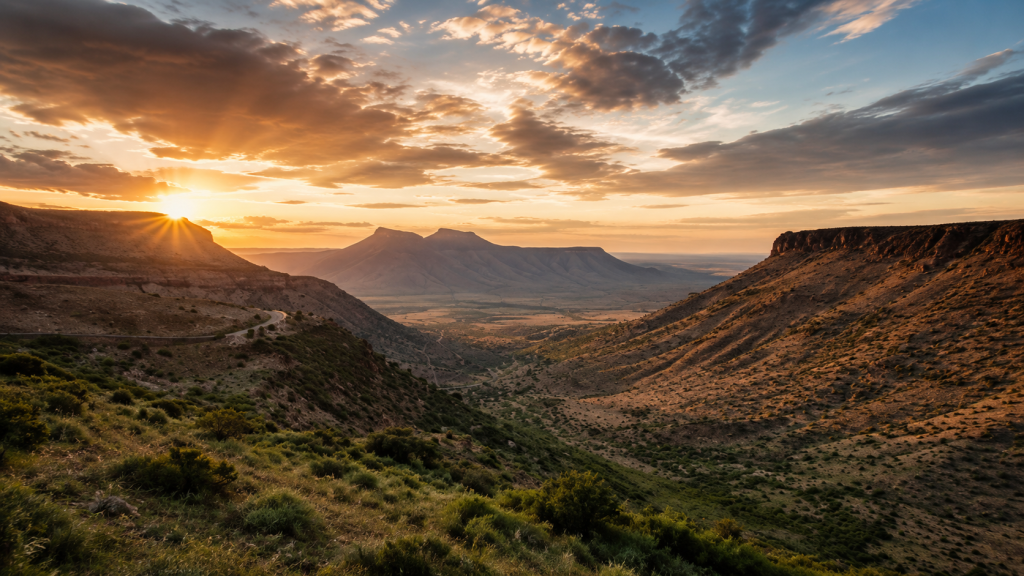
Karoo National Park is best known for its dramatic landscapes and remarkable adaptation of wildlife to a harsh, semi-desert environment. Visitors are drawn to expansive open spaces, towering escarpments, and panoramic views that stretch across seemingly endless horizons. The park offers excellent opportunities for wildlife viewing, hiking, birdwatching, mountain biking, and scenic drives.
Unlike South Africa’s more densely vegetated safari destinations, Karoo National Park provides a unique experience where geological features and wide-open landscapes are as much a part of the attraction as the wildlife itself. Its peaceful atmosphere and striking scenery make it a favorite destination for travelers seeking solitude and natural beauty.
The geography of Karoo National Park is dominated by the Nuweveld Mountains, broad plains, deep valleys, and rocky escarpments. The park lies within the Great Karoo, a vast semi-arid plateau shaped by thousands of years of geological activity and erosion. Elevations range from open lowlands to rugged mountain ridges that provide spectacular viewpoints across the surrounding landscape.
Seasonal rivers and drainage systems carve through the terrain, supporting pockets of vegetation in an otherwise dry environment. Plant communities include hardy shrubs, succulents, grasses, and drought-resistant species adapted to limited rainfall. These ecosystems form part of the globally significant Karoo biome, one of the world’s most distinctive arid regions.
Wildlife within Karoo National Park has recovered significantly through ongoing conservation efforts. Large mammals include Cape mountain zebra, black rhinoceros, buffalo, eland, kudu, gemsbok, red hartebeest, springbok, and klipspringer. Predators such as lion, leopard, black-backed jackal, bat-eared fox, and caracal inhabit the park, though some are more elusive than others. The park is also notable for its successful reintroduction of species that historically occurred within the region.
Birdlife is exceptional, with more than 240 recorded species. Visitors may observe Verreaux’s eagles soaring above cliffs, secretary birds striding across open plains, and a variety of raptors, larks, chats, and endemic Karoo species. The diversity of wildlife demonstrates the ecological richness of this seemingly harsh environment.
Karoo National Park plays a critical role in conserving one of South Africa’s most unique ecosystems. The park protects important habitats for rare wildlife while preserving geological landscapes that illustrate the natural history of the Karoo. Its conservation significance is often compared to protected areas such as Mountain Zebra National Park and Tankwa Karoo National Park, which also safeguard important semi-arid habitats and species.
As pressures from development and climate change continue to affect arid environments, Karoo National Park serves as a vital refuge for biodiversity and ecological research. Today, it remains one of South Africa’s most remarkable national parks, preserving the wild beauty and unique character of the Great Karoo for future generations.
Things to See
Things To Do
Engaging Karoo National Park
