

About
Tsitsikamma National Park is located along South Africa’s southern coastline in the Eastern Cape Province. The park covers approximately 310 square miles (800 sq km) of protected marine and coastal environments and forms one of the most celebrated sections of the larger Garden Route National Park.
Established in 1964, Tsitsikamma was South Africa’s first marine national park and remains one of the country’s most iconic conservation areas. The name “Tsitsikamma” is derived from a Khoisan word often translated as “place of abundant water” or “clear water,” reflecting the region’s dramatic coastline, rivers, and lush forests. Situated between Plettenberg Bay and Jeffrey’s Bay, the park protects a remarkable blend of ocean, forest, and mountain ecosystems.
Tsitsikamma National Park is best known for its spectacular coastal scenery, ancient indigenous forests, and world-renowned hiking trails. Visitors are drawn to towering sea cliffs, rocky shorelines, suspension bridges, and panoramic ocean views that rank among the most impressive in Africa.
One of the park’s most famous attractions is the Otter Trail, widely considered one of the world’s premier multi-day hiking routes. Adventure seekers also enjoy kayaking, snorkeling, scuba diving, ziplining, and exploring the park’s scenic walking trails. The combination of rugged coastline and pristine natural landscapes makes Tsitsikamma one of South Africa’s most popular outdoor destinations.
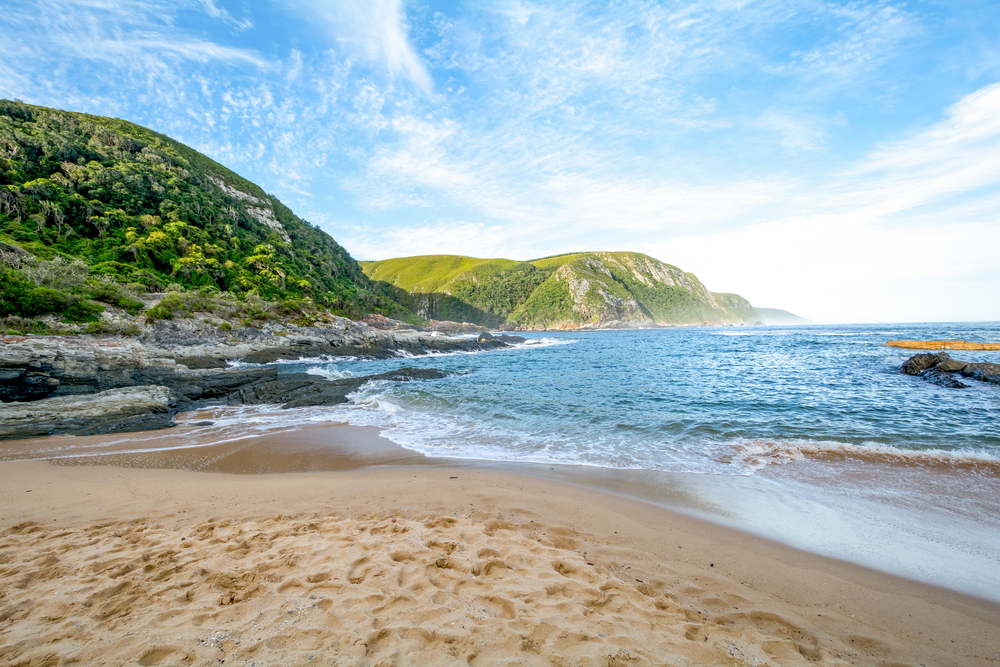
The geography of Tsitsikamma National Park is defined by the meeting of the Indian Ocean and the foothills of the Tsitsikamma Mountains. The coastline features dramatic cliffs, rocky headlands, sea caves, and narrow river gorges carved by rivers flowing from the mountains to the ocean.
Inland areas contain dense indigenous forests dominated by yellowwood, stinkwood, and other native tree species. Rivers such as the Storms River cut through deep gorges before reaching the sea, creating some of the park’s most iconic scenery. Frequent rainfall and a mild coastal climate support lush vegetation and contribute to the region’s extraordinary ecological diversity.
Wildlife within Tsitsikamma National Park includes both terrestrial and marine species. Forest mammals include bushbuck, vervet monkeys, baboons, caracals, and several smaller mammals adapted to woodland habitats. Offshore waters support dolphins, Cape fur seals, and seasonal visitors such as southern right whales and humpback whales. The marine protected area contains diverse fish populations, reefs, and intertidal ecosystems that support abundant marine life.
Birdlife is equally impressive, with species such as the Knysna turaco, African oystercatcher, Cape gannet, cormorants, kingfishers, and numerous forest and coastal birds inhabiting the park. The diversity of habitats creates opportunities to observe wildlife across both land and sea.
Tsitsikamma National Park plays a vital role in conserving one of South Africa’s most important coastal and marine ecosystems. As the country’s first marine national park, it pioneered marine conservation efforts that continue to benefit biodiversity today. The park protects critical breeding habitats, indigenous forests, river systems, and marine environments that support countless species.
Its conservation significance is often compared to Table Mountain National Park and other internationally recognized coastal protected areas where terrestrial and marine ecosystems are managed together. Today, Tsitsikamma remains one of South Africa’s most treasured natural destinations, preserving a landscape where forests, mountains, rivers, and ocean combine to create one of the most beautiful environments on the continent.
Things to See
Things To Do
Engaging Tsitsikamma National Park
