

About
Bui National Park is located in west-central Ghana along the Black Volta River near the border with Côte d’Ivoire. Established as a wildlife reserve in 1971 and upgraded to national park status in 1974, the park covers approximately 704 square miles (1,821 sq km), making it one of Ghana’s largest protected areas.
The park lies within the transition zone between the country’s forest and savanna ecosystems, creating a unique environment that supports diverse plant and animal life. Bui is particularly important as one of the last strongholds for several large mammal species in Ghana.
The park is best known for its population of hippopotamuses along the Black Volta River, one of the largest remaining hippo populations in West Africa. Visitors are drawn to boat safaris, wildlife viewing, birdwatching, and opportunities to explore one of Ghana’s most remote wilderness areas.
The river and surrounding landscapes provide scenic views that contrast with the country’s more densely populated regions. Because tourism remains relatively limited, visitors often experience a sense of solitude and authenticity that is increasingly rare in many African protected areas.
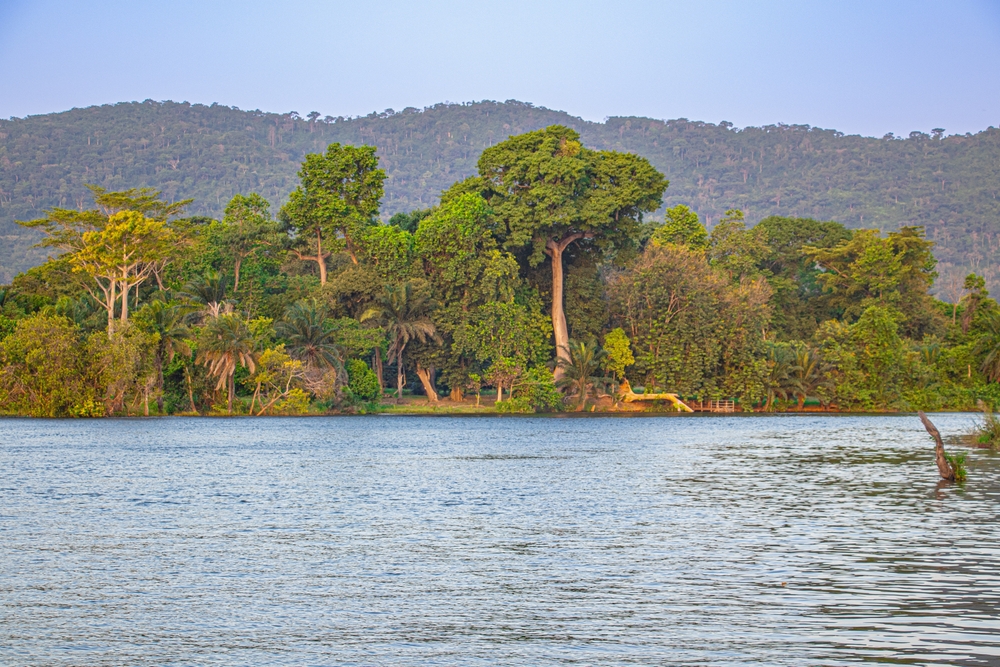
Geographically, Bui National Park encompasses a diverse landscape of riverine habitats, savanna woodlands, gallery forests, grasslands, and rocky outcrops. The Black Volta River serves as the park’s defining feature, winding through the protected area and creating important aquatic habitats.
The park lies within a transition zone where Guinea savanna ecosystems blend with patches of moist forest, resulting in high ecological diversity. Seasonal rainfall patterns influence vegetation growth and wildlife movements throughout the year. The construction of the nearby Bui Dam has altered portions of the landscape, creating new reservoirs while also presenting conservation challenges.
Wildlife within Bui National Park includes more than 60 mammal species and over 300 bird species. The park is especially famous for the Hippopotamus populations that inhabit the Black Volta River. Other mammals include buffalo, kob antelope, bushbuck, waterbuck, hartebeest, patas monkeys, olive baboons, civets, and various small carnivores.
Although populations have declined over time, elephants and leopards have historically occurred within the park. Birdlife is particularly impressive, with kingfishers, herons, bee-eaters, hornbills, fish eagles, and numerous migratory species utilizing the park’s varied habitats. The river also supports fish, reptiles, and amphibians that contribute to the park’s ecological richness.
Bui National Park plays a vital role in conserving one of Ghana’s most important wildlife landscapes. The park protects critical habitat for hippos and other large mammals, safeguards watersheds associated with the Black Volta River, and preserves biodiversity within a unique forest-savanna transition zone.
Its conservation significance is often compared to Mole National Park and Pendjari National Park because of its large mammals, river ecosystems, and importance for West African conservation. Through its scenic waterways, rich biodiversity, hippo populations, and diverse habitats, Bui National Park stands as one of Ghana’s most valuable protected areas and a cornerstone of the nation’s natural heritage.
Things to See
Things To Do
Engaging Bui National Park

Park Protection
Bui National Park was created to protect the woodland savannas, riverine forests, and freshwater ecosystems surrounding the Black Volta River in west-central Ghana. The park provides important habitat for several species of conservation concern, including the vulnerable hippopotamus, which represents one of the largest remaining hippo populations in Ghana.
Other wildlife protected within the park includes African elephants, leopards, buffalo, roan antelope, kob, waterbuck, and numerous species of primates and birds. The Black Volta River and its associated wetlands support critical aquatic habitats that sustain both wildlife and local ecological processes.
The park is especially significant for protecting Ghana’s largest remaining population of hippopotamuses and one of the country’s most important river ecosystems. The combination of savanna, woodland, and river habitats creates exceptional biodiversity and serves as an important wildlife corridor in the region.
Bui also protects portions of the transition zone between forest and savanna ecosystems, supporting species characteristic of both habitat types. Together, Bui National Park safeguards vulnerable hippos, important populations of large mammals, critical freshwater habitats, and one of Ghana’s most ecologically diverse protected landscapes.
FAQ’s
What is the main reason people visit Bui National Park?
Bui National Park is primarily visited for its wildlife, hippopotamus populations, Black Volta River ecosystem, and remote wilderness experience.
Located in west-central Ghana along the border with Côte d’Ivoire, the park protects approximately 704 square miles (1,821 square kilometers) of savanna woodland, riverine forest, grassland, and aquatic habitats.
Visitors come to see hippos, antelope, primates, birds, and one of Ghana’s most important freshwater ecosystems.
What animals can visitors hope to see in Bui National Park?
Bui National Park supports more than 60 mammal species and numerous reptiles and amphibians. The park is particularly important for its hippopotamus population along the Black Volta River.
Some of the most notable animals found in Bui National Park include:
- Hippopotamus
- African Buffalo
- Roan Antelope
- Kob
- Bushbuck
- Defassa Waterbuck
- Oribi
- Red-flanked Duiker
- Common Duiker
- Maxwell’s Duiker
- Bohor Reedbuck
- Warthog
- Bushpig
- Olive Baboon
- Patas Monkey
- Green Monkey
- Black-and-White Colobus Monkey
- Spot-nosed Monkey
- Tantalus Monkey
- Leopard
- African Wildcat
- Serval
- Caracal
- Side-striped Jackal
- Spotted Hyena
- African Civet
- Large-spotted Genet
- Common Genet
- Honey Badger
- White-tailed Mongoose
- Marsh Mongoose
- Slender Mongoose
- Egyptian Mongoose
- African Clawless Otter
- Tree Hyrax
- Cane Rat
- Giant Pouched Rat
- Brush-tailed Porcupine
- African Hare
- Ground Squirrel Species
- Fruit Bat Species
- Horseshoe Bat Species
- Pipistrelle Species
- Shrew Species
- Forest Mouse Species
- Nile Crocodile
- African Rock Python
- Black-necked Spitting Cobra
- Puff Adder
- Nile Monitor
What birds can visitors hope to see in Bui National Park?
Bui National Park is home to more than 300 bird species, including resident savanna birds, wetland species, and migratory birds. The Black Volta River provides important habitat for waterbirds and raptors.
Some of the most popular birds seen in Bui National Park include:
- African Fish Eagle
- Martial Eagle
- Bateleur
- Tawny Eagle
- Brown Snake Eagle
- Wahlberg’s Eagle
- Secretary Bird
- Palm-nut Vulture
- Hooded Vulture
- White-backed Vulture
- Saddle-billed Stork
- Yellow-billed Stork
- Marabou Stork
- Woolly-necked Stork
- African Openbill
- African Spoonbill
- Sacred Ibis
- Hadada Ibis
- Hamerkop
- Great White Pelican
- Pink-backed Pelican
- African Darter
- Great Cormorant
- Spur-winged Goose
- Egyptian Goose
- White-faced Whistling Duck
- African Jacana
- Black Crake
- Grey Crowned Crane
- Black Crowned Crane
- Kori Bustard
- White-bellied Bustard
- Abyssinian Ground Hornbill
- Yellow-billed Hornbill
- Red-billed Hornbill
- Giant Kingfisher
- Pied Kingfisher
- Malachite Kingfisher
- Woodland Kingfisher
- Lilac-breasted Roller
- Blue-bellied Roller
- Carmine Bee-eater
- Red-throated Bee-eater
- Senegal Parrot
- Violet Turaco
- Piapiac
- Fork-tailed Drongo
- Yellow-billed Oxpecker
- African Paradise Flycatcher
- Northern Red Bishop
Is Bui National Park worth visiting?
Yes, Bui National Park is worth visiting, particularly for travelers interested in wildlife, birdwatching, river ecosystems, and less-crowded national park experiences.
The park offers excellent opportunities to observe hippopotamuses, waterbirds, antelope, and primates in a scenic river environment. Visitors seeking an authentic wilderness experience often appreciate the park’s relatively undeveloped nature.
The primary hesitation is that tourism infrastructure is more limited than in Ghana’s better-known parks such as Mole National Park and Kakum National Park. Wildlife can also be more difficult to locate because of the park’s dense vegetation and large area.
What is the best time to visit Bui National Park?
Weather and Climate
The best time to visit Bui National Park is during the dry season from November through March.
Typical conditions include:
- November–February: 65–95°F (18–35°C)
- March–April: 75–105°F (24–41°C)
- May–October: Rainy season, 70–95°F (21–35°C)
During the dry season:
- Wildlife gathers near water sources.
- River wildlife is easier to observe.
- Roads are generally more accessible.
- Birdwatching remains productive.
- Vegetation is less dense.
The rainy season produces lush landscapes but may make travel more challenging.
How many days do you need to visit Bui National Park?
Most visitors plan for 1 to 3 days depending on their availability and desires for what to experience.
- 1 day: River and wildlife viewing.
- 2 days: Wildlife observation, birdwatching, and boat activities.
- 3 days: Comprehensive exploration of the park.
- 4+ days: Extended wildlife photography and birding.
Two days is generally recommended for most visitors.
How do you get to Bui National Park?
International Access
Bui National Park is located in west-central Ghana.
The primary international gateway is:
- Kotoka International Airport
Most visitors begin their journey in Accra.
Regional Airport Access
The closest regional airport is:
- Sunyani Airport
Visitors often continue from Sunyani by road to the park.
Driving from Accra
Travel time from Accra:
- Approximately 250 miles (400 km)
- About 6–8 hours by road
Driving from Sunyani
Travel time from Sunyani:
- Approximately 70–90 miles (110–145 km)
- About 2–3 hours by road
Black Volta River
The defining feature of the park is:
- Black Volta River
The river provides:
- Hippopotamus habitat.
- Birdwatching opportunities.
- Scenic landscapes.
- Freshwater ecosystems.
Bui Reservoir
Following construction of the nearby hydroelectric project, portions of the park are associated with:
- Bui Reservoir
This large waterbody has become an important habitat for aquatic wildlife.
Travel Times
Typical travel times include:
- Accra to Bui National Park: 6–8 hours.
- Kumasi to Bui National Park: 4–5 hours.
- Sunyani to Bui National Park: 2–3 hours.
A four-wheel-drive vehicle may be helpful during the rainy season.
Who is involved in protecting and supporting Bui National Park?
Several organizations help protect and support Bui National Park:
- Ghana Wildlife Division – manages Bui National Park.
- Forestry Commission of Ghana – oversees wildlife and protected-area management.
- Nature and Development Foundation – supports conservation initiatives.
- A Rocha Ghana – supports biodiversity conservation and environmental education.
- Local communities surrounding the park that participate in conservation and ecotourism activities.
What is unique about Bui National Park?
Bui National Park is unique because it protects one of Ghana’s most important river ecosystems and supports one of the country’s largest hippopotamus populations. Unlike many West African parks that are dominated by savanna landscapes, Bui combines woodland, riverine habitats, wetlands, and freshwater ecosystems centered around the Black Volta River. This combination of aquatic wildlife, bird diversity, and remote wilderness makes Bui one of Ghana’s most distinctive national parks.