

About
Located along the Atlantic coastline north of Cape Town, West Coast National Park protects one of South Africa’s most important coastal and wetland ecosystems. The park covers approximately 140 square miles (363 sq km) surrounding the beautiful Langebaan Lagoon and stretches across sandy beaches, salt marshes, islands, and fynbos-covered landscapes.
Established in 1985, the park lies within the biodiverse Cape Floral Region and serves as a major refuge for migratory birds and endemic plant species. Its proximity to Cape Town makes it one of the country’s most accessible and scenic national parks.
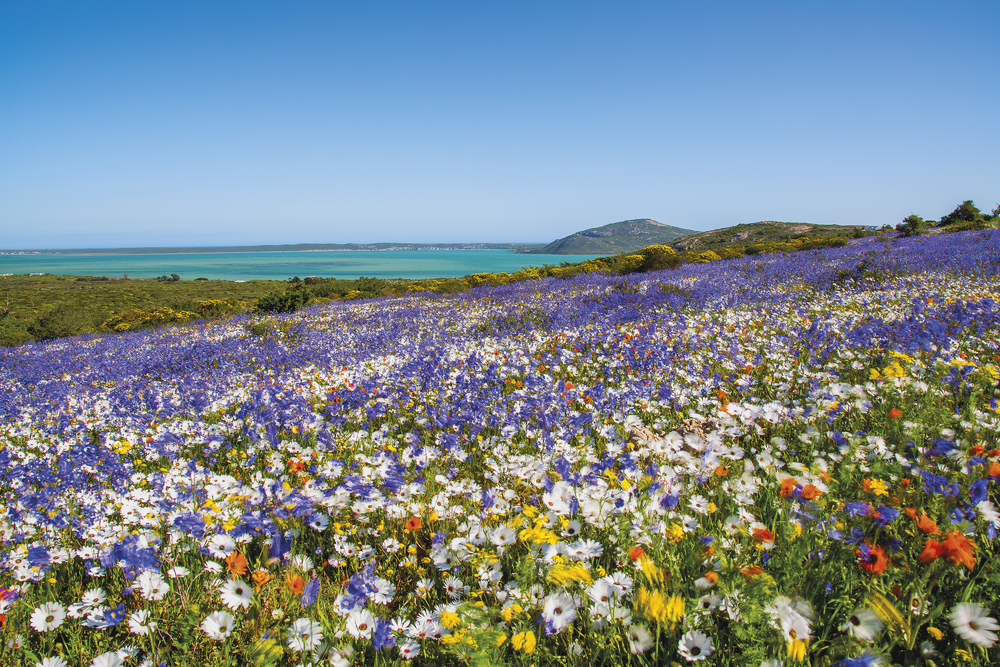
West Coast National Park is best known for its spectacular spring wildflower displays, peaceful coastal scenery, and internationally important birdlife. During the spring months, usually between August and September, large sections of the park burst into vibrant color as thousands of wildflowers bloom across the landscape.
This transformation attracts photographers, botanists, and travelers from around the world. The turquoise waters of Langebaan Lagoon provide another iconic feature of the park and create excellent opportunities for kayaking, birdwatching, hiking, cycling, and wildlife viewing. Visitors often enjoy the calm atmosphere and slower pace compared to some of South Africa’s more heavily visited safari parks. Scenic drives through the reserve offer breathtaking views of beaches, wetlands, and rolling coastal vegetation.
The geography of West Coast National Park is shaped by coastal dunes, rocky shorelines, tidal flats, wetlands, and low-lying fynbos landscapes. Langebaan Lagoon forms the heart of the park and is one of the few saltwater lagoons in the world that supports such rich biodiversity. The lagoon’s calm waters contrast beautifully with the rugged Atlantic coastline beyond.
Vegetation is dominated by fynbos and strandveld ecosystems filled with shrubs, flowering plants, succulents, and grasses uniquely adapted to the Mediterranean climate of the Western Cape. Seasonal rainfall patterns strongly influence the park’s appearance, with dry summers and cooler, wetter winters helping sustain the floral diversity for which the region is famous.
Wildlife within West Coast National Park is especially important for bird conservation. Thousands of migratory birds arrive seasonally from Europe and other parts of Africa, making the lagoon one of the continent’s key wetland habitats. Flamingos, pelicans, sandpipers, oystercatchers, gulls, and terns are frequently observed throughout the park.
More than 250 bird species have been recorded within the reserve. Mammals include eland, bontebok, springbok, mountain zebras, caracals, and small antelope species that move through the fynbos and grasslands. Marine life along the coast includes dolphins, whales during migration seasons, and numerous fish species supported by the nutrient-rich Atlantic waters.
West Coast National Park plays a globally significant role in protecting the Cape Floral Kingdom, one of the richest and most unique plant regions on Earth. Many species found within the park occur nowhere else in the world. The park also safeguards critical coastal wetlands and migratory bird habitats increasingly threatened by development and climate change.
Compared to coastal parks such as Table Mountain National Park or Doñana National Park, West Coast National Park offers a quieter experience centered around wetlands, flowers, and coastal biodiversity rather than dramatic mountains or dense tourism. Its combination of floral beauty, birdlife, and peaceful coastal landscapes makes it one of South Africa’s most treasured natural sanctuaries.
Photos


Things to See
West Coast National Park Trails
Hiking and biking around West Coast National Parks and the coastal trails provide visitors with a great chance to discover and explore the marine protected area.

Sources
- Africa Sky, West Coast National Park, https://www.africansky.com/african-travel/south-africa/destinations/national-parks/west-coast-national-park, retrieved July 2020.
- Britannica, Saldanha Bay, https://www.britannica.com/place/Saldanha-Bay, retrieved July 2020.
- Lonely Planet, West Coast National Park, https://www.lonelyplanet.com/south-africa/west-coast-national-park, retrieved July 2020.
- Siyabona Africa, West Coat National Park, http://www.nature-reserve.co.za/west-coast-national-park-history-wildlife.html, retrieved July 2020.
- South African National Park, West Coast National Park, https://www.sanparks.org/parks/west_coast/, retrieved July 2020.
- South Africa Venues, West Coast National Park, https://www.sa-venues.com/game-reserves/wc_westcoast.htm, retrieved July 2020.
- South Africa Venues, Langebaan Lagoon, https://www.sa-venues.com/attractionswc/langebaan-lagoon.php, retrieved July 2020.