

About
Taman Negara National Park is located in the heart of Peninsular Malaysia and spans the states of Pahang, Kelantan, and Terengganu. Established as King George V National Park in 1938 and renamed after Malaysia’s independence, Taman Negara covers approximately 1,677 square miles (4,343 sq km), making it one of the largest protected areas in the country.
The park protects a vast expanse of tropical rainforest thousands of years old, making it one of the oldest continuously existing rainforests on Earth. Its immense biodiversity, ancient forests, and extensive wilderness have earned Taman Negara recognition as one of Southeast Asia’s premier national parks.
The park is best known for its ancient rainforest and exceptional wildlife. Visitors travel from around the world to experience dense jungle landscapes, river adventures, canopy walkways, and opportunities to encounter some of Malaysia’s most iconic species.
Popular activities include jungle trekking, night safaris, river cruises, cave exploration, and climbing Mount Tahan, the highest peak in Peninsular Malaysia at 7,175 feet (2,187 m). The park’s famous canopy walkway, suspended high above the forest floor, offers a unique perspective of the rainforest ecosystem and remains one of the most popular attractions in the park.
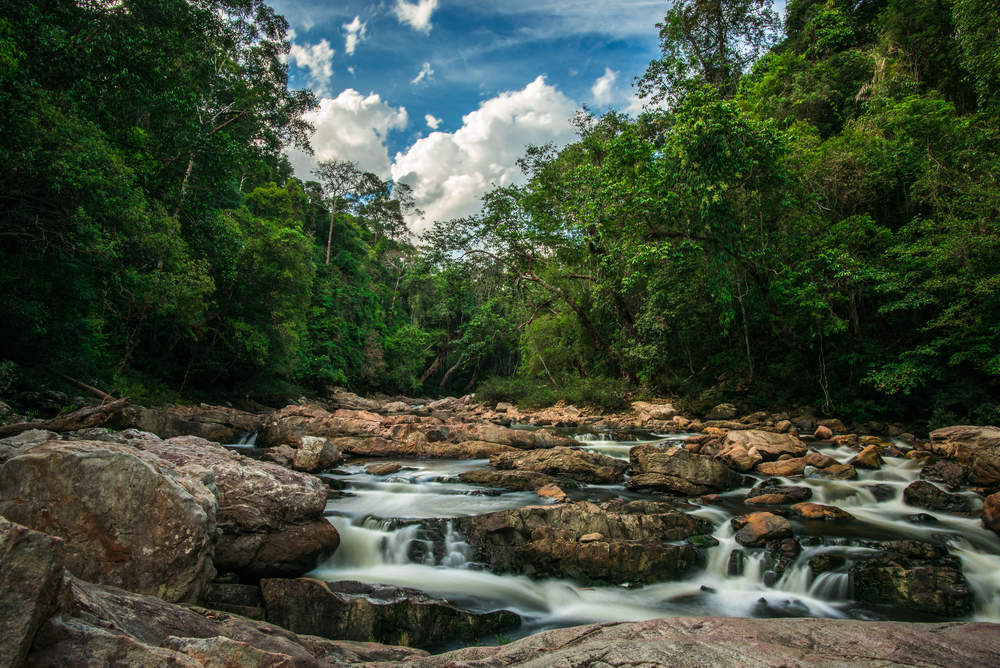
Geographically, Taman Negara encompasses rugged mountains, rolling hills, dense lowland and montane rainforests, rivers, waterfalls, and limestone caves. The Tembeling, Tahan, and other river systems flow through the park, creating important transportation routes and wildlife habitats.
The park’s varied elevations support a wide range of ecosystems, from lowland dipterocarp forests to cloud forests at higher elevations. Towering emergent trees, lianas, orchids, palms, and ferns create a complex rainforest structure that supports one of the richest biological communities in Asia. Frequent rainfall and year-round warmth sustain lush vegetation throughout the park.
Wildlife diversity is one of Taman Negara’s greatest treasures. The park provides habitat for some of Southeast Asia’s most endangered mammals, including the Malayan tiger, Asian elephant, Malayan tapir, sun bear, clouded leopard, and gaur. Primates such as white-handed gibbons, dusky leaf monkeys, and long-tailed macaques inhabit the forest canopy.
More than 350 bird species have been recorded, including rhinoceros hornbills, great argus pheasants, kingfishers, broadbills, and numerous migratory species. Reptiles, amphibians, freshwater fish, insects, and countless plant species further contribute to the park’s extraordinary biodiversity.
Taman Negara National Park plays a crucial role in conserving one of the world’s oldest rainforest ecosystems. The park protects critical watersheds, preserves habitat for endangered wildlife, and serves as a living laboratory for scientific research. Its ecological importance is often compared to globally renowned rainforest reserves such as Gunung Mulu National Park and Corcovado National Park because of its biodiversity, ancient forests, and conservation significance.
Through its towering trees, rare wildlife, pristine rivers, and vast wilderness, Taman Negara National Park stands as Malaysia’s flagship national park and one of the most important rainforest sanctuaries on Earth.
Sources
Britannica, taman Negara, https://www.britannica.com/place/Taman-Negara-National-Park, retrieved April 2024.
Malaysia Tourism, Taman Negara, https://www.malaysia.travel/explore/taman-negara, retrieved April 2024.
Park Site, Multi Taman Negara, https://www.mutiaratamannegara.com/, retrieved April 2024.
Park Site, Taman Negara, https://www.tamannegara.asia/, retrieved April 2024.