

About
Saint Katherine National Park (Arabic: محمية سانت كاترين), also known as Saint Catherine Protectorate, is located in the southern portion of the Egypt’s Sinai Peninsula. Established in 1988, the park covers approximately 1,670 square miles (4,330 sq km), making it one of Egypt’s largest protected areas.
Centered around the town of Saint Catherine, the park encompasses some of the highest mountains in Egypt, including the country’s tallest peak, Mount Catherine. The protected area lies within a rugged mountain landscape that has served as a crossroads of faith, culture, and nature for thousands of years. Its unique combination of natural and cultural heritage has earned international recognition, including designation as a UNESCO World Heritage Site.
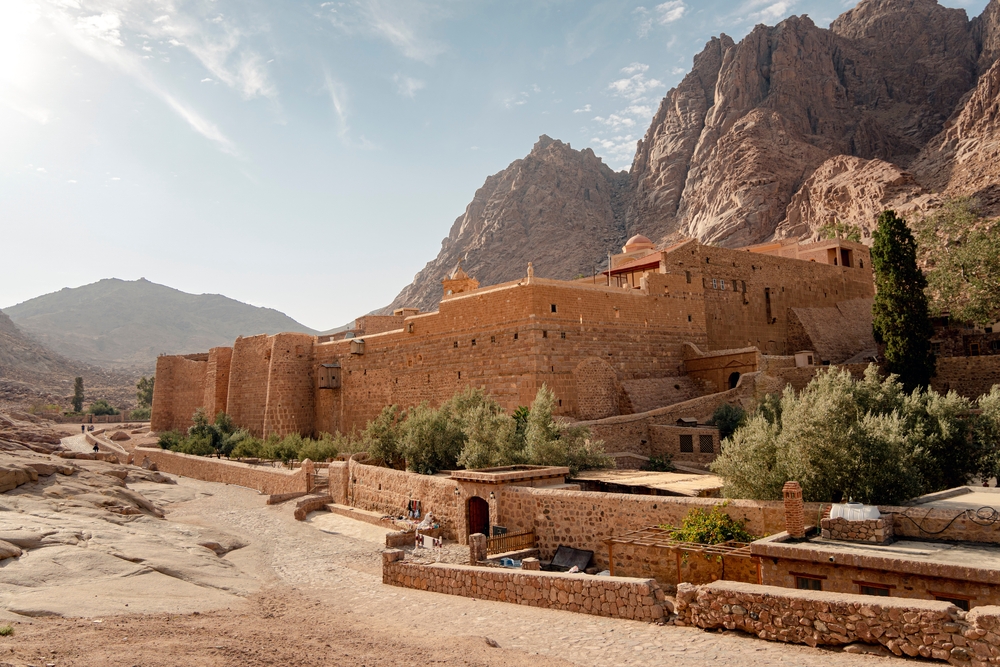
The park is best known for its profound religious significance and spectacular mountain scenery. At its heart lies Saint Catherine’s Monastery, one of the world’s oldest continuously operating Christian monasteries. Nearby stands Mount Sinai, traditionally regarded as the mountain where Moses received the Ten Commandments.
Pilgrims, hikers, and travelers from around the world visit the park to climb Mount Sinai before dawn and witness sunrise over the rugged Sinai mountains. This blend of spiritual history and natural beauty makes Saint Katherine one of the most remarkable protected areas in the Middle East.
Geographically, the park is dominated by towering granite mountains, deep valleys, narrow canyons, and high-altitude plateaus. Mount Catherine rises to approximately 8,625 feet (2,629 m), making it the highest point in Egypt. The rugged terrain creates numerous microclimates that support surprising biological diversity despite the region’s arid conditions.
Seasonal rainfall and mountain runoff sustain pockets of vegetation within valleys and sheltered areas. Acacia trees, wild herbs, desert shrubs, and rare endemic plants thrive in habitats that have persisted for millennia. The park contains one of the richest concentrations of plant diversity in Egypt, including many species found nowhere else in the world.
Wildlife within Saint Katherine National Park has adapted to survive in this harsh mountain environment. Mammals include the Nubian ibex, red fox, rock hyrax, and desert hare. The park also supports several species of bats and small rodents. Birdlife is particularly notable, with migratory birds utilizing the Sinai Peninsula as an important route between Africa, Europe, and Asia.
Eagles, vultures, wheatears, and numerous passerine species can be observed throughout the region. Reptiles are especially diverse, with several endemic lizards and snakes inhabiting the rocky landscape. The park’s isolation has contributed to the evolution of unique species found nowhere else on Earth.
Saint Katherine National Park plays a vital role in conserving one of the Middle East’s most important mountain ecosystems. It protects rare endemic plants, fragile desert habitats, and species specially adapted to high-altitude environments. Equally important is its preservation of cultural and religious landmarks that have shaped human history for centuries.
The park’s combination of spiritual significance, mountain biodiversity, and dramatic landscapes is often compared to places such as Sagarmatha National Park and Tongariro National Park, where natural wonders and sacred traditions coexist. Through its towering peaks, ancient monastery, unique wildlife, and enduring cultural legacy, Saint Katherine National Park stands as one of Egypt’s most treasured protected areas and a globally significant destination for both conservation and heritage preservation.
Things to See
Things To Do
Engaging Saint Katherine National Park

FAQ’s
What is the main reason people visit Saint Katherine National Park?
Saint Katherine National Park is primarily visited for its spectacular mountain landscapes, religious significance, hiking opportunities, and unique biodiversity. Located in the Sinai Peninsula of Egypt, the park is home to Egypt’s highest mountains, including Mount Catherine and Mount Sinai.
Visitors come to hike the famous Mount Sinai trail, visit the historic Saint Catherine’s Monastery, experience breathtaking desert scenery, and explore one of the most culturally and ecologically important protected areas in the Middle East.
What animals can visitors hope to see in Saint Katherine National Park?
Saint Katherine National Park supports approximately 30 mammal species and more than 25 reptile species. Although wildlife can be difficult to spot in the rugged mountain terrain, the park protects several rare desert and mountain species found nowhere else in Egypt.
Some of the most notable mammals and reptiles found in Saint Katherine National Park include:
- Nubian Ibex
- Dorcas Gazelle
- Rock Hyrax
- Red Fox
- Rüppell’s Fox
- Blanford’s Fox
- Egyptian Wolf
- Striped Hyena
- Wild Cat
- Caracal
- Egyptian Mongoose
- Cape Hare
- Desert Hedgehog
- Ethiopian Hedgehog
- Sinai Mouse
- Wagner’s Gerbil
- Lesser Egyptian Jerboa
- Greater Egyptian Jerboa
- Fat Sand Rat
- Sundevall’s Jird
- Tristram’s Jird
- Desert Dormouse
- Egyptian Fruit Bat
- Pipistrelle Bat Species
- Long-eared Bat Species
- Mouse-tailed Bat Species
- Sinai Agama
- Egyptian Spiny-tailed Lizard
- Sinai Fan-fingered Gecko
- Moorish Gecko
- Desert Monitor
- Egyptian Cobra
- Horned Desert Viper
- Saw-scaled Viper
- Diadem Snake
- Sand Boa
- Coin-marked Snake
- Arabian Cat Snake
- Whip Snake Species
- Mountain Skink Species
- Sinai Gecko Species
- Fringe-toed Lizard
- Desert Lacertid Species
- Sand Lizard Species
- Sinai Chameleon
- Wadi Racer
- False Cobra Species
- Leaf-toed Gecko Species
- Desert Skink Species
- Various endemic Sinai reptiles
What birds can visitors hope to see in Saint Katherine National Park?
Saint Katherine National Park is one of the most important birdwatching areas in the Middle East, with more than 200 recorded bird species. The park serves as a major migration corridor between Africa, Europe, and Asia and hosts several species found almost exclusively in the Sinai Mountains.
Some of the most popular birds seen in Saint Katherine National Park include:
- Sinai Rosefinch
- Tristram’s Starling
- Desert Lark
- Bar-tailed Lark
- Greater Hoopoe-Lark
- Mourning Wheatear
- White-crowned Wheatear
- Desert Wheatear
- Blackstart
- Hooded Wheatear
- Rock Martin
- Crag Martin
- Alpine Swift
- Common Swift
- Eurasian Hoopoe
- European Bee-eater
- Blue-cheeked Bee-eater
- Brown-necked Raven
- Fan-tailed Raven
- Sinai Bunting
- Rock Sparrow
- House Sparrow
- Chukar Partridge
- Sand Partridge
- Little Owl
- Pharaoh Eagle-Owl
- Eurasian Eagle-Owl
- Bonelli’s Eagle
- Golden Eagle
- Short-toed Snake Eagle
- Long-legged Buzzard
- Griffon Vulture
- Egyptian Vulture
- Lanner Falcon
- Barbary Falcon
- Peregrine Falcon
- Common Kestrel
- Eurasian Sparrowhawk
- Black Kite
- Western Marsh Harrier
- White Stork
- Black Stork
- European Honey Buzzard
- Steppe Eagle
- Lesser Spotted Eagle
- Greater Spotted Eagle
- Northern Wheatear
- Isabelline Wheatear
- Spectacled Warbler
- Sardinian Warbler
Is Saint Katherine National Park worth visiting?
Yes, Saint Katherine National Park is absolutely worth visiting and is one of Egypt’s most remarkable protected areas. It offers a unique combination of natural beauty, religious history, mountain adventure, and biodiversity.
Visitors can experience sunrise from Mount Sinai, explore ancient monasteries, hike Egypt’s highest peaks, and discover unique desert wildlife. Travelers seeking traditional safari wildlife may find fewer large animals than expected, but those interested in hiking, culture, history, and mountain scenery often consider it one of Egypt’s most rewarding destinations.
What is the best time to visit Saint Katherine National Park?
The best time to visit Saint Katherine National Park is from October through April.
During these months:
- Temperatures are cooler and more comfortable for hiking.
- Visibility is often excellent.
- Mountain trekking conditions are ideal.
- Wildlife activity is generally higher.
Winter can bring snow to the highest elevations, while summer temperatures can become very hot at lower elevations.
How many days do you need to visit Saint Katherine National Park?
Most visitors should plan for 2 to 3 days.
- 1 day: Mount Sinai sunrise hike and monastery visit.
- 2 days: Additional hiking and exploration of mountain valleys.
- 3 days: Comprehensive experience including longer treks, birdwatching, and cultural activities.
Serious hikers may wish to spend longer exploring the park’s extensive trail network.
How do you get to Saint Katherine National Park?
Saint Katherine National Park is located in South Sinai, Egypt.
Most visitors:
- Fly into Sharm El Sheikh.
- Travel approximately 2–3 hours by road to Saint Catherine.
- Access the park through the town of Saint Catherine.
Many visitors combine Saint Katherine with a visit to Ras Muhammad National Park or other Sinai destinations.
Is Saint Katherine National Park safe for tourists? Y
es, Saint Katherine National Park is generally considered safe for tourists and is one of Egypt’s most visited religious and hiking destinations.
Visitors should:
- Use local guides for longer mountain hikes.
- Carry adequate water and sun protection.
- Be prepared for cold temperatures at higher elevations.
- Follow guidance from park authorities and local security personnel.
- Check current travel advisories before travel.
Most visits occur without incident.
Who is involved in protecting and supporting Saint Katherine National Park?
Several organizations help protect Saint Katherine National Park:
- Egyptian Environmental Affairs Agency (EEAA) – manages the park and Egypt’s protected areas network.
- Nature Conservation Sector of Egypt – oversees biodiversity conservation and research.
- Saint Catherine Protectorate Management – responsible for local conservation and visitor management.
- St. Catherine Foundation – supports cultural and environmental preservation initiatives.
- Local Bedouin communities, particularly the Jebeliya tribe, who play a vital role in guiding visitors and preserving the area’s cultural and natural heritage.
Is Mount Sinai located inside Saint Katherine National Park?
Yes. Mount Sinai is located within Saint Katherine National Park and is one of the park’s most famous attractions. According to tradition, it is the mountain where Moses received the Ten Commandments, making it an important pilgrimage destination for Jews, Christians, and Muslims.