

About
Lobéké National Park, locally known as “Parc National de Lobéké”, is a vital conservation area located in the southeastern corner of Cameroon, near the borders of the Central African Republic and the Republic of Congo. Spanning approximately 2,150 square kilometers (830 square miles), it is part of the Congo Basin’s Tri-National de la Sangha (TNS) transboundary conservation initiative. Established in 2001, the park is renowned for its rich biodiversity and unique ecosystems, making it a critical refuge for wildlife and a key component of global conservation efforts.
The terrain of Lobéké National Park is predominantly lowland tropical rainforest, interspersed with swamps, river systems, and forest clearings known as “bais”—natural salt licks that attract a wide variety of wildlife. These clearings are some of the park’s most iconic features, offering visitors unparalleled opportunities to observe animals in their natural habitat. The park’s dense forests are characterized by towering hardwood trees, lush undergrowth, and an intricate network of rivers and streams that support its diverse ecosystems.
Lobéké is home to an extraordinary array of wildlife, including some of Africa’s most iconic and endangered species. Forest elephants, western lowland gorillas, and chimpanzees are among the park’s flagship species. Other notable mammals include leopards, giant pangolins, and bongos. The park is also a birdwatcher’s paradise, with species such as African grey parrots, hornbills, and turacos thriving in its forests. Reptiles, amphibians, and a wealth of invertebrates further contribute to the park’s ecological richness.
Visitors to Lobéké National Park can engage with its natural beauty through guided treks, wildlife observation, and eco-tourism activities centered around the forest clearings. The bais offer prime opportunities to observe elephants, gorillas, and other animals as they gather to feed on mineral-rich soil. Birdwatching is another highlight, with a chance to spot rare and colorful species in their natural habitats. River excursions and camping experiences allow visitors to immerse themselves in the park’s pristine wilderness. Additionally, interactions with indigenous Baka communities provide cultural enrichment, offering insights into traditional forest-based lifestyles and sustainable practices.
Despite its ecological and cultural significance, Lobéké National Park faces numerous challenges. Poaching, particularly for bushmeat and ivory, poses a severe threat to its wildlife. Logging and agricultural expansion encroach on the park’s boundaries, leading to habitat degradation. Climate change and the illegal wildlife trade further exacerbate these pressures. Conservation efforts led by the Cameroonian government, in collaboration with international organizations, focus on anti-poaching patrols, habitat restoration, and community-based initiatives. The park’s inclusion in the TNS initiative promotes cross-border collaboration, enhancing conservation outcomes across the region.
Lobéké National Park is a cornerstone of Cameroon’s natural heritage and a critical player in global biodiversity conservation. Its dense rainforests, unique wildlife, and cultural connections make it an invaluable resource for eco-tourism and scientific research. Protecting Lobéké ensures the survival of its ecosystems and supports broader efforts to preserve the Congo Basin’s ecological legacy for future generations.
Things to See
Things To Do
Engaging Lobéké National Park

Park Protection
Lobéké National Park was created to protect the lowland tropical rainforests, forest clearings (bais), rivers, and wetlands of southeastern Cameroon within the Congo Basin. The park provides critical habitat for several endangered species, including the endangered African forest elephant, the western lowland gorilla, and the endangered central chimpanzee.
It also supports important populations of leopards, bongo antelope, forest buffalo, giant forest hogs, sitatungas, and numerous smaller mammals. More than 300 bird species have been recorded within the park, including the endangered gray-necked rockfowl and many species characteristic of the Congo Basin rainforest. Its extensive forests form part of one of the largest remaining intact tropical rainforest ecosystems on Earth.
The park is especially significant for protecting its natural forest clearings, known as bais, where elephants, gorillas, bongos, and many other species gather to feed on mineral-rich soils and vegetation. These clearings provide some of the best opportunities in Central Africa to observe rainforest wildlife in its natural habitat.
Lobéké also forms part of the transboundary Sangha Trinational, a UNESCO World Heritage Site that connects three internationally important rainforest protected areas. Together, Lobéké National Park safeguards endangered great apes, forest elephants, unique rainforest bais, and one of the most important tropical forest conservation landscapes in Central Africa.
FAQ’s
What is the main reason people visit Lobéké National Park?
Lobéké National Park is primarily visited for its exceptional rainforest wildlife, forest elephants, western lowland gorillas, and world-famous wildlife clearings known as bais. Located in southeastern Cameroon near the borders of the Republic of the Congo and the Central African Republic, the park protects one of the most biologically rich regions of the Congo Basin.
Visitors come to observe rare rainforest species, experience pristine tropical forests, and witness wildlife gathering at mineral-rich forest clearings that offer some of the best wildlife-viewing opportunities in Central Africa.
What animals can visitors hope to see in Lobéké National Park?
Lobéké National Park supports more than 100 mammal species and over 70 reptile species. The park is internationally recognized for its populations of great apes, forest elephants, and numerous rare rainforest mammals.
Some of the most notable mammals found in Lobéké National Park include:
- African Forest Elephant
- Western Lowland Gorilla
- Central Chimpanzee
- Forest Buffalo
- Bongo
- Yellow-backed Duiker
- Blue Duiker
- Bay Duiker
- Peters’s Duiker
- Ogilby’s Duiker
- Water Chevrotain
- Sitatunga
- Bushbuck
- Red River Hog
- Giant Forest Hog
- Leopard
- African Golden Cat
- Serval
- African Civet
- African Palm Civet
- Long-tailed Pangolin
- Giant Pangolin
- Tree Pangolin
- Brush-tailed Porcupine
- African Brush-tailed Porcupine
- Putty-nosed Monkey
- Crowned Monkey
- Moustached Monkey
- De Brazza’s Monkey
- Grey-cheeked Mangabey
- Black Colobus
- Olive Colobus
- Red-capped Mangabey
- Allen’s Bushbaby
- Potto
- Tree Hyrax
- African Clawless Otter
- Congo Clawless Otter
- Marsh Mongoose
- White-tailed Mongoose
- Slender Mongoose
- Large-spotted Genet
- Forest Genet
- Rope Squirrel Species
- Sun Squirrel Species
- Gambian Giant Pouched Rat
- Forest Shrew Species
- Fruit Bat Species
- Horseshoe Bat Species
- Pipistrelle Bat Species
What birds can visitors hope to see in Lobéké National Park?
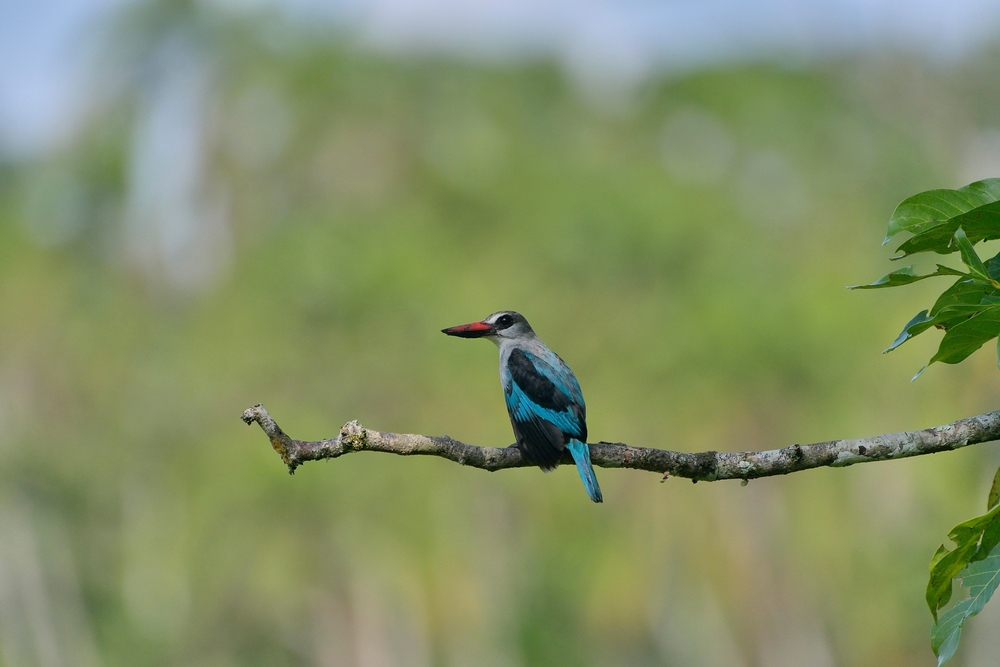
Lobéké National Park is one of the premier birdwatching destinations in the Congo Basin, with more than 300 recorded bird species. The park contains a remarkable variety of rainforest birds, including hornbills, parrots, raptors, kingfishers, bee-eaters, and several species that are difficult to observe elsewhere in Africa.
Some of the most popular birds seen in Lobéké National Park include:
- Grey Parrot
- Great Blue Turaco
- Yellow-casqued Hornbill
- Black-casqued Hornbill
- White-thighed Hornbill
- Piping Hornbill
- Red-billed Dwarf Hornbill
- African Green Pigeon
- Western Bronze-naped Pigeon
- Afep Pigeon
- Blue-headed Wood Dove
- Black Guineafowl
- Hartlaub’s Duck
- White-crested Tiger Heron
- African Finfoot
- Congo Serpent Eagle
- Crowned Eagle
- Cassin’s Hawk-Eagle
- Long-tailed Hawk
- African Harrier-Hawk
- Nkulengu Rail
- Lyre-tailed Honeyguide
- Yellow-spotted Barbet
- Naked-faced Barbet
- Yellow-billed Barbet
- Red-rumped Tinkerbird
- Chocolate-backed Kingfisher
- Blue-headed Bee-eater
- Black Bee-eater
- Rosy Bee-eater
- African Dwarf Kingfisher
- Shining-blue Kingfisher
- African Pitta
- Rufous-sided Broadbill
- White-tailed Ant Thrush
- Forest Robin
- Fire-crested Alethe
- Fraser’s Forest Flycatcher
- Yellow-footed Flycatcher
- African Paradise Flycatcher
- Blue-billed Malimbe
- Crested Malimbe
- Red-vented Malimbe
- Rachel’s Malimbe
- Purple-headed Starling
- Splendid Glossy Starling
- Tiny Sunbird
- Johanna’s Sunbird
- Western Olive Sunbird
- Superb Sunbird
Is Lobéké National Park worth visiting?
Yes, Lobéké National Park is absolutely worth visiting for wildlife enthusiasts, birdwatchers, conservation travelers, and anyone interested in experiencing one of Africa’s most intact rainforest ecosystems. The opportunity to observe forest elephants, gorillas, chimpanzees, and bongos at forest clearings is a wildlife experience unlike traditional savanna safaris.
The primary consideration is that the park is remote and requires more effort to access than many African national parks. Wildlife viewing often requires patience, and rainforest conditions can be physically demanding. However, for serious nature travelers, Lobéké is one of Central Africa’s most rewarding destinations.
What is the best time to visit Lobéké National Park?
The best time to visit Lobéké National Park is during the drier seasons:
- December to February
- June to August
During these months:
- Forest trails are generally more accessible.
- Wildlife viewing at bais is often better.
- Travel conditions improve.
- Birdwatching remains excellent.
Rainfall is possible year-round because of the park’s equatorial rainforest climate.
How many days do you need to visit Lobéké National Park?
Most visitors should plan for 3 to 5 days.
- 2 days: Introduction to the park and wildlife clearings.
- 3 days: Wildlife viewing, forest walks, and birdwatching.
- 4–5 days: Comprehensive rainforest experience with opportunities for gorilla and chimpanzee tracking, bai observation, and photography.
Researchers and dedicated wildlife enthusiasts often spend a week or longer in the park.
How do you get to Lobéké National Park?
Lobéké National Park is located in southeastern Cameroon near the tri-border region with the Republic of the Congo and the Central African Republic.
Most visitors:
- Fly into Yaoundé or Douala.
- Travel to Yokadouma, the primary gateway town.
- Continue by road to the park entrance with a guide or tour operator.
Travel can take considerable time due to the park’s remote location and road conditions.
Is Lobéké National Park safe for tourists?
Lobéké National Park is generally safe for tourists who visit with authorized guides and established operators.
Visitors should:
- Travel with experienced guides.
- Follow all park regulations.
- Be prepared for remote rainforest conditions.
- Arrange logistics through reputable operators.
- Review current travel advisories before visiting.
The greatest challenges are often logistical and environmental rather than wildlife-related.
Who is involved in protecting and supporting Lobéké National Park?
Several organizations contribute to the protection of Lobéké National Park:
- Ministry of Forestry and Wildlife (MINFOF) – the government agency responsible for managing Cameroon’s protected areas.
- Lobéké National Park Conservancy – oversees park management and conservation activities.
- World Wide Fund for Nature (WWF) Cameroon – has played a major role in conservation, wildlife monitoring, and community engagement in the region.
- Tri-National de la Sangha (TNS) – a transboundary conservation initiative linking Lobéké with neighboring protected areas.
- Local Baka and other Indigenous communities who contribute valuable traditional ecological knowledge and participate in conservation efforts.
Can you see gorillas in Lobéké National Park?
Yes. Lobéké National Park is home to the endangered Western Lowland Gorilla. While sightings are not guaranteed due to the dense rainforest environment, the park is considered one of the most important strongholds for the species in Central Africa.
Why is Lobéké National Park part of the Tri-National de la Sangha conservation area?
Lobéké National Park forms part of the Tri-National de la Sangha (TNS), a UNESCO-recognized transboundary conservation landscape that connects protected areas in Cameroon, the Republic of the Congo, and the Central African Republic. This cooperation helps protect one of the largest remaining intact rainforest ecosystems on Earth and supports the conservation of elephants, gorillas, chimpanzees, and many other species.
Sources
Here are sources you can explore for more information:
- AllTrails. Lobéké National Park. https://www.alltrails.com/cameroon/east/lobeke-national-park, retrieved July 2026.
- Cameroon Ministry of Forestry and Wildlife (MINFOF). Lobéké National Park. https://www.minfof.cm/, retrieved July 2026.
- Encyclopaedia Britannica. Lobéké National Park. https://www.britannica.com/place/Lobeke-National-Park, retrieved July 2026.
- Protected Planet (UNEP-WCMC & IUCN). Lobéké National Park. https://www.protectedplanet.net/, retrieved July 2026.
- SafariBookings. Lobéké National Park. https://www.safaribookings.com/lobeke, retrieved July 2026.
- UNESCO World Heritage Centre. Sangha Trinational. https://whc.unesco.org/en/list/1380/, retrieved July 2026.
- Wikipedia. Lobéké National Park. https://en.wikipedia.org/wiki/Lob%C3%A9k%C3%A9_National_Park, retrieved July 2026.
- World Wildlife Fund (WWF). Northwestern Congolian Lowland Forests. https://www.worldwildlife.org/ecoregions/at0129, retrieved July 2026.