

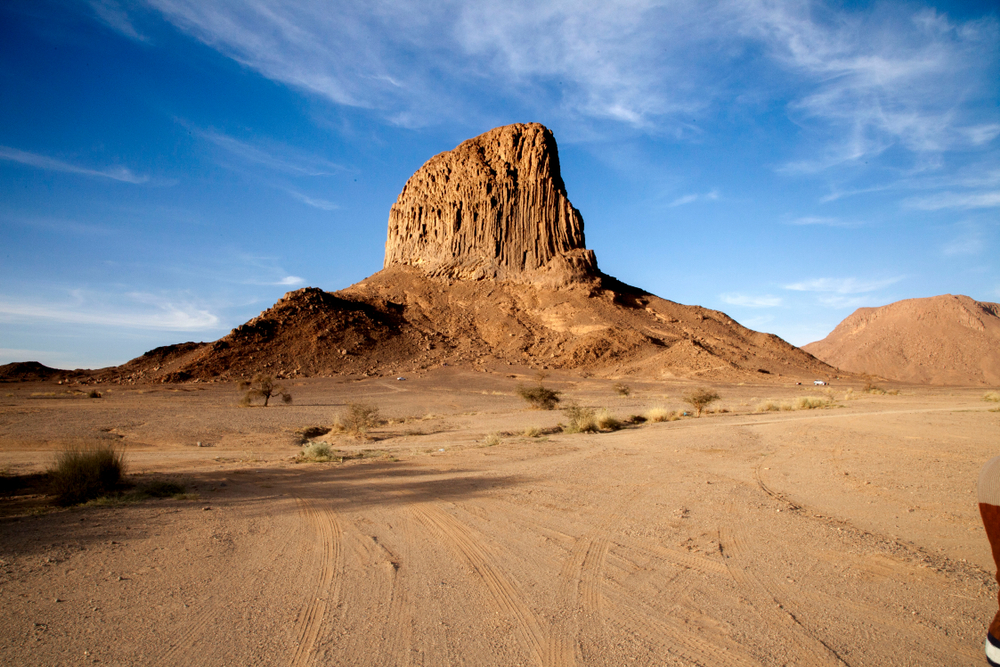
About
Ahaggar National Park (Arabic: الحديقة الوطنية للأهقار; also known as Hoggar National Park) is located in southern Algeria within the vast Ahaggar Mountains near the city of Tamanrasset. Established in 1987, the park covers approximately 173,750 square miles (450,000 sq km), making it one of the largest protected areas in Africa and among the largest national parks in the world.
The park protects a substantial portion of the central Sahara and encompasses the rugged Ahaggar Massif, an ancient volcanic mountain range rising dramatically above the surrounding desert. Neighboring protected areas include the vast Tassili n’Ajjer National Park to the northeast, together forming one of the most significant conservation landscapes in the Sahara.
The park is best known for its spectacular desert mountain scenery, towering volcanic peaks, and rich cultural heritage. At its heart stands Mount Tahat, Algeria’s highest mountain, reaching 9,573 feet (2,918 m) above sea level. Visitors are drawn to Ahaggar National Park by its dramatic rock formations, sweeping desert vistas, and remarkable sense of isolation.
The region has long been home to the Tuareg people, whose traditions, culture, and deep knowledge of the desert remain an important part of the park’s identity. Ancient caravan routes, rock art sites, and historic settlements add a cultural dimension that complements the park’s natural beauty.
The geography of Ahaggar National Park is among the most distinctive in the Sahara. The landscape consists of volcanic mountains, basalt plateaus, granite peaks, deep valleys, sand seas, and rocky deserts known as hamadas. Millions of years of erosion have sculpted extraordinary rock formations that rise abruptly from the surrounding plains.
Despite the harsh climate, the park contains isolated wadis and mountain refuges where vegetation persists. Acacias, desert grasses, tamarisks, and hardy shrubs survive in areas that receive occasional rainfall. Higher elevations experience cooler temperatures and support plant communities rarely found elsewhere in the central Sahara.
Wildlife within the park is specially adapted to survive in one of the world’s most challenging environments. Mammals include Barbary sheep, dorcas gazelles, fennec foxes, sand cats, and desert hedgehogs. Although rarely seen, cheetahs and other predators have historically inhabited portions of the region. B
irdlife includes desert larks, ravens, wheatears, and migratory species that utilize mountain habitats during seasonal movements. Reptiles such as monitor lizards, geckos, and horned vipers are well adapted to the arid landscape. The mountain massifs serve as important refuges for wildlife that cannot survive in the surrounding desert plains.
Ahaggar National Park plays a critical role in preserving both natural and cultural treasures of the Sahara. The park protects rare desert ecosystems, isolated populations of wildlife, and important archaeological and cultural sites associated with the Tuareg and earlier civilizations. Its mountain refuges provide essential habitat for species that have persisted through dramatic climatic changes over thousands of years.
In ecological significance and landscape grandeur, Ahaggar is often compared to Namib-Naukluft National Park and Wadi Rum Protected Area, yet its immense scale and volcanic mountain scenery make it uniquely Saharan. Through its rugged peaks, sweeping deserts, rich cultural heritage, and resilient wildlife, Ahaggar National Park stands as one of Africa’s most remarkable protected landscapes and one of the great wilderness areas of the world.
Things to See
Things To Do
Engaging Ahaggar National park

FAQ’s
What is the main reason people visit Ahaggar National Park?
Ahaggar National Park is primarily visited for its spectacular Sahara Desert landscapes, dramatic volcanic mountains, ancient rock art, and rich Tuareg cultural heritage. Located in southern Algeria, the park protects much of the Ahaggar (Hoggar) Mountains, one of the most scenic and geologically unique regions in the Sahara.
Visitors come to explore towering basalt peaks, vast desert plateaus, rugged canyons, prehistoric archaeological sites, and some of the most breathtaking sunrises and sunsets in North Africa.
What animals can visitors hope to see in Ahaggar National Park?
Ahaggar National Park supports approximately 50 mammal species and more than 30 reptile species adapted to extreme desert and mountain environments. While wildlife densities are lower than in savanna parks, the region protects several rare Saharan species that have disappeared from much of their historic range.
Some of the most notable mammals and reptiles found in Ahaggar National Park include:
- Barbary Sheep (Aoudad)
- Dorcas Gazelle
- Slender-horned Gazelle
- Dama Gazelle (rare)
- Cuvier’s Gazelle
- Addax (historically present, extremely rare)
- Fennec Fox
- Rüppell’s Fox
- Pale Fox
- Sand Fox
- African Wildcat
- Sand Cat
- Caracal
- Saharan Cheetah
- Leopard (historically present, now extremely rare)
- Striped Hyena
- Golden Jackal
- Honey Badger
- Common Genet
- African Civet
- Egyptian Mongoose
- Cape Hare
- Desert Hare
- Lesser Egyptian Jerboa
- Greater Egyptian Jerboa
- Fat Sand Rat
- Shaw’s Jird
- Sundevall’s Jird
- Desert Dormouse
- Rock Hyrax
- Long-eared Hedgehog
- Desert Hedgehog
- Egyptian Tomb Bat
- Trident Leaf-nosed Bat
- Desert Pipistrelle
- Saharan Gerbil
- Wagner’s Gerbil
- North African Gundi
- Common Gundi
- Four-toed Jerboa
- Libyan Jird
- African Wolf
- African Ground Squirrel
- Desert Shrew
- White-bellied Hedgehog
- Lesser Mouse-tailed Bat
- Greater Mouse-tailed Bat
- Desert Mouse Species
- Rock Rat Species
- Various Desert Bat Species
What birds can visitors hope to see in Ahaggar National Park?
Ahaggar National Park hosts more than 120 bird species, including resident desert birds, mountain specialists, and migratory species that use the Sahara as a seasonal flyway. While bird diversity is lower than in wetter ecosystems, the park offers opportunities to observe species specially adapted to harsh desert conditions.
Some of the most popular birds found in Ahaggar National Park include:
- Brown-necked Raven
- Desert Sparrow
- Trumpeter Finch
- House Bunting
- Mourning Wheatear
- White-crowned Wheatear
- Black Wheatear
- Desert Wheatear
- Red-rumped Wheatear
- African Desert Warbler
- Bar-tailed Lark
- Hoopoe Lark
- Greater Hoopoe-Lark
- Temminck’s Lark
- Thick-billed Lark
- Short-toed Lark
- Desert Lark
- Sand Partridge
- Pharaoh Eagle-Owl
- Little Owl
- Long-legged Buzzard
- Bonelli’s Eagle
- Golden Eagle
- Lanner Falcon
- Barbary Falcon
- Peregrine Falcon
- Common Kestrel
- Egyptian Vulture
- Griffon Vulture
- Eurasian Crag Martin
- Rock Martin
- Blue Rock Thrush
- Common Raven
- White-rumped Swift
- Alpine Swift
- European Bee-eater
- Blue-cheeked Bee-eater
- Eurasian Hoopoe
- Cream-colored Courser
- Greater Short-toed Lark
- Northern Wheatear
- Isabelline Wheatear
- Black Redstart
- Rufous-tailed Scrub Robin
- Spectacled Warbler
- Sardinian Warbler
- Common Chiffchaff
- Desert Finch
- Rock Sparrow
- Common Swift
Is Ahaggar National Park worth visiting?
Yes, Ahaggar National Park is absolutely worth visiting for travelers interested in desert landscapes, geology, photography, cultural heritage, trekking, and remote wilderness experiences. Many visitors consider the Hoggar Mountains among the most beautiful desert mountain ranges in the world.
The main consideration is that Ahaggar is not a traditional wildlife safari destination. Visitors seeking abundant large mammals may be disappointed, while those interested in dramatic scenery, ancient cultures, stargazing, and desert exploration often find it unforgettable.
What is the best time to visit Ahaggar National Park?
The best time to visit Ahaggar National Park is from October through April.
During these months:
- Daytime temperatures are more comfortable.
- Hiking conditions are excellent.
- Visibility for photography is often ideal.
- Desert camping is more enjoyable.
Summer temperatures from May through September can be extremely hot, particularly at lower elevations.
How many days do you need to visit Ahaggar National Park?
Most visitors should plan for 3 to 5 days.
- 1–2 days: Highlights around Tamanrasset.
- 3 days: Mountain scenery, rock formations, and cultural sites.
- 4–5 days: Comprehensive exploration including remote areas, trekking, and overnight desert camps.
Photographers and adventure travelers often spend a week or longer in the region.
Seeing highlights of the park can be accomplished in a day, but to truly experience the park and what it has to offer, visitors should plan for more time.
How do you get to Ahaggar National Park?
Most visitors access Ahaggar National Park through the city of Tamanrasset.
Typical access involves:
- Flying to Algiers.
- Taking a domestic flight to Tamanrasset.
- Traveling into the park by four-wheel-drive vehicle with a guide.
Because of the remote terrain, guided tours are strongly recommended.
Is Ahaggar National Park safe for tourists?
Ahaggar National Park can be visited safely when travelers follow current government guidance, use authorized local guides, and travel with reputable tour operators.
Visitors should:
- Monitor travel advisories before departure.
- Travel with experienced guides.
- Carry adequate water and supplies.
- Avoid independent travel in remote desert areas.
- Follow local regulations and security requirements.
Conditions can change, so checking current information before travel is essential.
Who is involved in protecting and supporting Ahaggar National Park?
Several organizations help protect Ahaggar National Park:
- Direction Générale des Forêts – the Algerian government agency responsible for national parks and protected areas.
- Office National du Parc Culturel de l’Ahaggar – oversees management of the Ahaggar cultural and natural landscape.
- Ministry of Culture and Arts of Algeria – supports protection of archaeological and cultural heritage sites.
- Tuareg communities throughout the Ahaggar region, whose traditional knowledge contributes significantly to conservation and sustainable land stewardship.
- Algerian universities and research institutions conducting studies on desert ecology, archaeology, and geology.
Can you climb Mount Tahat in Ahaggar National Park?
Yes. Mount Tahat, at approximately 2,908 meters (9,541 feet), is the highest mountain in Algeria. Experienced hikers and climbers can reach the summit with appropriate preparation and local guidance. The mountain offers spectacular views across the Sahara.